Supporting without speaking for the person
Putting a board in front of someone is not enough. What happens next depends on the attitude of the person opposite, and that is the hardest part.
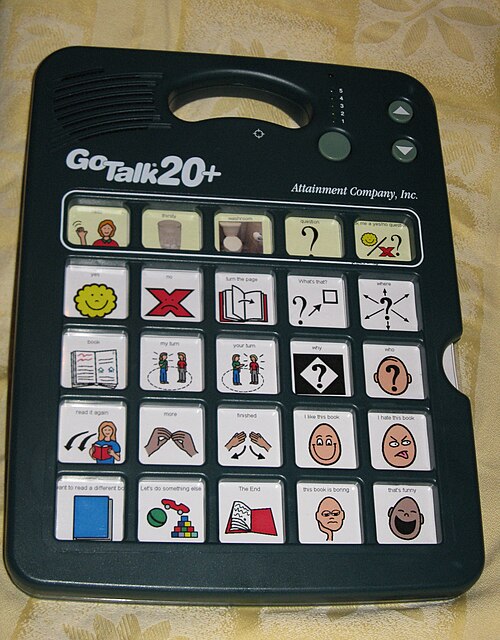

Words Within Reach is a free and openly licensed communication aid. It is not a medical device, not medical advice, and not a rehabilitation programme. This page describes ways of doing things; it replaces neither the opinion of a speech and language therapist nor the support agreed with the person and their family.
The starting point: the person understands
Speak to the person directly, in words suited to their age, not to the person supporting them over their shoulder. Do not talk about them in the third person while they are in the room. Difficulty speaking is not difficulty understanding, and no one has ever lost anything by assuming more understanding in another person than they show.
Modelling, without asking anything
The most effective way to teach someone to use a board is to use it yourself while speaking: you say “would you like a drink?” while touching the cell “drink”, you say “we have finished” while touching “finished”. Nothing is required in return. A research review devoted to this practice, in which the communication partner points to the symbols while speaking, examined its effects on language acquisition in people with complex communication needs: it is one of the best-studied practices in the field.
A useful order of magnitude: someone learning to speak hears tens of thousands of words before saying their own. There is no reason for a board to be an exception: it is modelled for a long time before it is used.
Allowing time
The silence after a question is not a refusal to answer: it is often an answer on its way. Looking for a cell, raising a hand, aiming, pressing: each of these movements takes time, and the reflex of finishing the other person’s sentence is the hardest one to unlearn. Counting slowly to ten before asking again feels endless at first, and stops feeling that way after a few days.
What turns a tool into a chore
- Asking “show me the dog” to check that the person knows. A board is for saying things, not for proving them.
- Bringing the board out only when an answer is expected: it then turns into an interrogation.
- Stringing closed questions together. They test our own assumptions, they take none in.
- Correcting the wording. A three-cell sentence that is understood is a successful sentence.
- Praising every gesture as an achievement. Respond to the message, not to the effort.
The board stays there, all the time
Available at all times, visible, within reach of the person’s gesture, including when nobody is asking anything of them, including during meals, journeys and quiet moments. A board kept in a bag is no use, and a board brought out only in sessions mainly teaches that speaking happens only in sessions.
It is never taken away as a punishment. Taking away someone’s means of being understood is taking away their voice.
Accepting what is uncomfortable
A board must make it possible to refuse, to stop, to protest, to say no, to say you do not like something, to ask someone to leave. That is why “stop” and “no” are among the twelve cells present on every board. A tool that only lets a person be polite and give the right answer is not a communication tool: it is an exercise. And a refusal expressed through a cell is better, for everyone, than a refusal expressed another way.
The words belong to the person
The names of the people close to them, their dishes, their places, their habits, the subjects they talk about: these are added with the person, not on their behalf, and they are removed if the person does not use them. The photographs they choose belong to them, stay on the device, and go nowhere. See my boards.
The most widespread fear
“If you give him pictures, he will never speak.” A review of the literature covering twenty-three studies and sixty-seven people concludes that the use of augmentative and alternative communication neither slowed nor prevented the development of speech, and that spoken output increased in 89% of participants. Its authors state that only six studies had adequate experimental control: we carry that caution over as it stands, and do not turn it into a promise.
What belongs to a professional
The choice of a means of communication for a given person, the assessment of their needs, the organisation of support: these belong to a speech and language therapist and to the team who know them. This site judges no one, measures no one and replaces no one. It makes available a free, openly licensed and printable aid, ready straight away, including while an appointment is being waited for.
Sources
- AAC Modeling Intervention Research Review, Sennott, Light and McNaughton, Research and Practice for Persons with Severe Disabilities, 2016, 41(2), pp. 101-115 (ERIC record): a review of research on AAC modelling by the communication partner.
- The impact of augmentative and alternative communication intervention on the speech production of individuals with developmental disabilities: a research review, Millar, Light and Schlosser, 2006, DARE critical abstract, National Library of Medicine (PubMed record).
- Augmentative and Alternative Communication, practice portal of the American Speech-Language-Hearing Association.
- How it works: the design choices behind the boards, and the reasons for them.