The symbols and their licences
A symbol is somebody’s drawing. Before serving it, we read its licence in the file delivered with the set, and we rule out anything that would stop our readers from freely re-using their boards.

The rule, in three lines
- The licence is read in the file of the set itself, not on a presentation page or a badge: a set whose licence cannot be verified does not come in.
- No non-commercial clause, ever, not even for a non-profit association.
- ShareAlike sets are admitted, but in a separate module that shows its licence, never merged with the others.
Why a non-commercial clause is refused
The question is not what ODERSA is allowed to do, but what you will be allowed to do with our boards. A non-commercial clause travels: it spreads to every board built with those pictures. A private institution, a supported-employment business, an educational publisher, a paid service could no longer use them, and a therapist in private practice would have to ask the question at every printout. A communication tool that cannot circulate freely misses its purpose.
This is why the symbol set most widely used in augmentative and alternative communication in the French-speaking world, which carries a non-commercial clause, is not served here. This is no judgement on its quality, which is high: it is a consequence of its licence.
The two families served
The permissive core
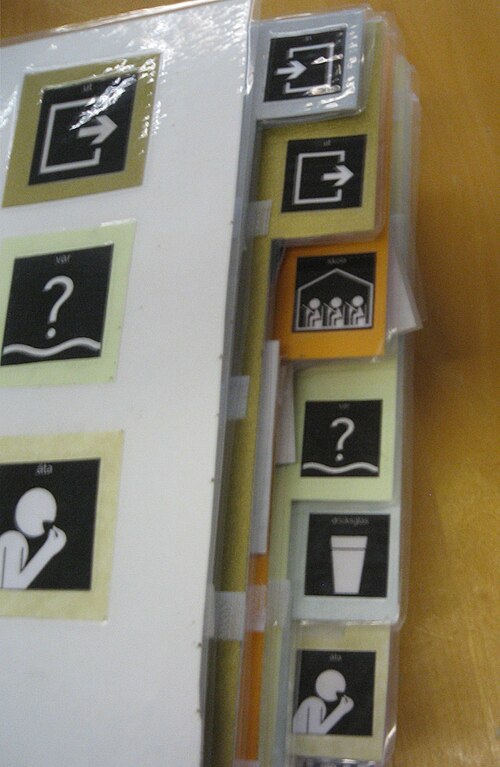
It asks for attribution, and nothing more. It is the set that makes up the ready-made boards by default, so that any board produced here can be re-used with no hidden obligation. It brings together colour graphics, recognisable for objects, food, places and emotions, and line symbols for function words, where plainness serves better than detail.
The ShareAlike module
It offers a set designed specifically for augmentative and alternative communication, richer than the core set on verbs, body parts and health words. Its licence requires any board that uses it to be distributed under the same licence. The service tells you so at the moment you choose this module, and the boards that come from it carry their licence, on screen as in print.
The exact names of the sets, their authors, the attribution to copy and the address of the licence file that was read are on the credits page, where they are produced at every build from the files themselves.
What a symbol does not do
A picture does not speak on its own. The same drawing can point to an object, an action or a wish depending on the person and the culture, and a badly chosen symbol can make someone say the opposite of what was meant. This is why every cell also carries its written word, why the position of the cells stays stable from one board to another, and why you can replace any picture with a photograph of your own.
If a picture does not match its label, or if it is understood differently where you are, say so: these reports come before the others.
What we do not do
We do not draw our own symbols, and we do not have any produced by a machine. An approximate drawing in a communication tool is worse than no drawing: it settles a misunderstanding that the person cannot correct out loud. We prefer to use the work of illustrators who did it for that purpose, and to credit it.
Sources
- Global Symbols, which catalogues symbol sets and their declared licence. We use it to rule a set out, never to let one in: admission goes through the licence file of the set itself.
- CC BY 4.0, CC BY-SA 4.0, Apache 2.0: the official texts of the licences used.
- Licence and re-use, for what you may do with our boards.