At school
A pupil who does not speak has things to say in class: to ask, to refuse, to choose, to say they have not understood. This page is for teachers, for those who support them and for parents.
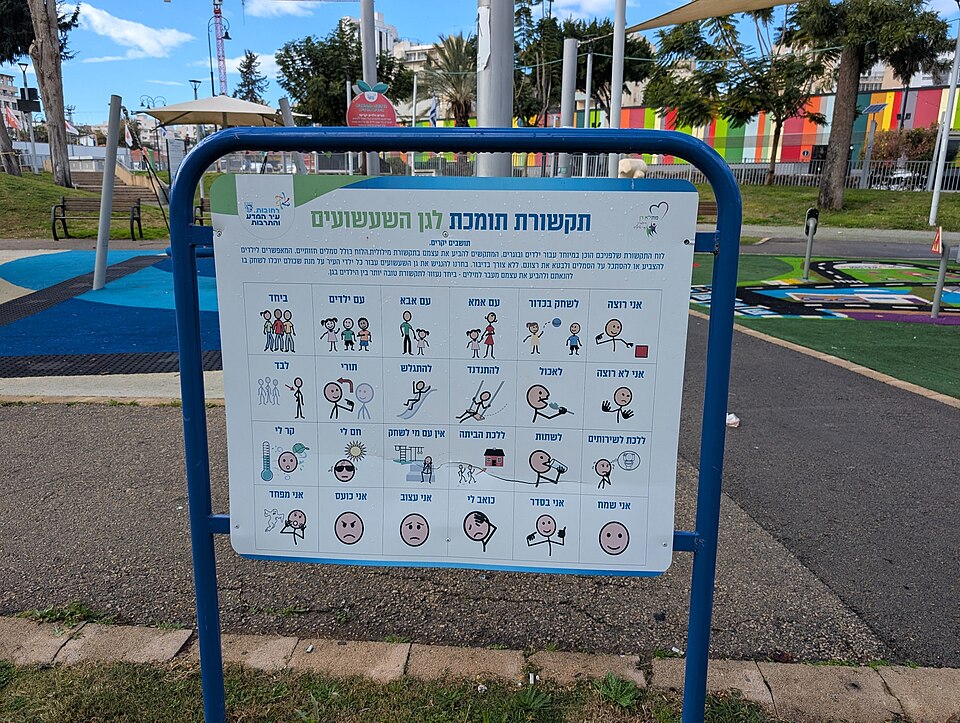

Words Within Reach is a free and openly licensed communication aid. It is not a medical device, not medical advice, and not a prescribed teaching tool. The choice of support for a pupil rests with the team following them, with their family and with the professionals who know them.
What a board makes possible in the classroom
- Taking part: answering, suggesting, choosing between two activities.
- Asking for: help, equipment, to leave, a break, a repetition.
- Saying that you have not understood, which is often the hardest message to get across without speech.
- Refusing, stopping, protesting. A tool that only lets a person be polite and give the right answer is not a communication tool: it is an exercise.
- Saying what is fine and what is not, including when nobody has asked.
What can be put in place today, with no budget
- Open the ready-made boards and pick out the ones that match the school day.
- Print it, laminate it if you can, and put the board on the pupil’s desk. One copy in the school bag, one copy in the classroom.
- Using it yourself in front of the pupil, pointing to the cells while you speak, without asking anything of them in return.
- Leaving the board available at all times, including when nobody is asking anything of it. A board brought out only when an answer is expected turns into an interrogation.
The vocabulary of a school day
The words of a classroom are not those of a hospital: the names of classmates, the places in the school, the subjects, the equipment, the moments of the day, the games in the playground. These words are added in my boards, with photographs if they help, and they are added with the pupil, never on their behalf: it is the pupil who knows what they need to talk about.
The same twelve cells are in the same place on every board, including the ones you build yourself. A pupil who has learnt where “help” is finds it in the classroom, in the dining hall and at home, without looking for it.
What this site does not do
- It assesses nothing and marks nothing. No score, no progress tracking, and nothing sent anywhere: not to the school, and not to us.
- It does not replace the choice of support for a given pupil: that choice belongs to the team following them, to their family and to the professionals who know them.
- It diagnoses nothing and prescribes no equipment.
- It does not replace a board already in use: if the pupil uses another tool, that tool takes precedence, because the stability of their landmarks matters more than our preferences.
A board is never a reward
It is not taken away as a punishment, it is not earned, and it is not put away during quiet moments. Taking away someone’s means of being understood is taking away their voice.
What a school or a public body can do with the service
- Printing in bulk for a whole institution, without asking our permission: see licence and re-use.
- Adapting the boards to local arrangements and to the language of instruction: the symbols stay, the labels are translated.
- Adding these boards to your own teaching resources, crediting the source.
- Writing to us about a school situation the boards do not cover: contact.
This groundwork holds for a classroom in any country: one pupil, one adult supporting them, one board. Administrative schemes, acronyms and educational rights vary from one country to another, and this site says nothing about them: those questions go to the school and to the competent authorities, not to a communication tool.
Sources
- The impact of augmentative and alternative communication intervention on the speech production of individuals with developmental disabilities: a research review, Millar, Light and Schlosser, 2006: the use of augmentative and alternative communication neither slowed nor prevented the development of speech in the studies reviewed, with the methodological reservations that the authors set out.
- Frequency of word usage by Hebrew preschoolers: implications for AAC core vocabulary, 2023: the most frequent words account for most of what children produce.
- How it works: the design choices behind the boards, and the reasons for them.